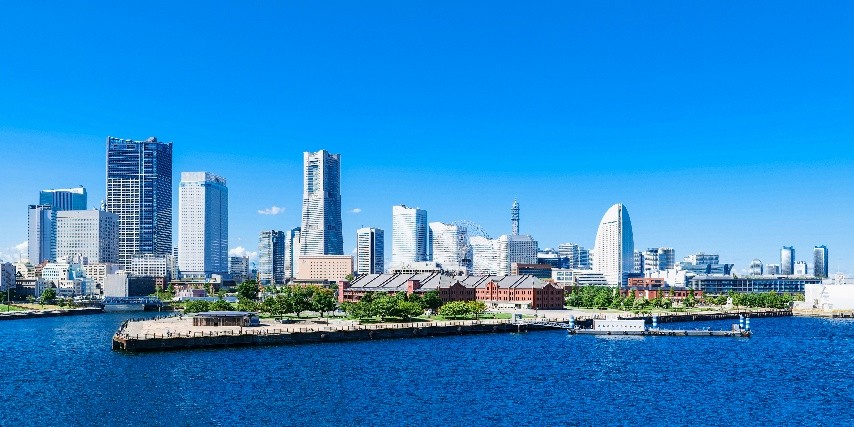
The Minato Mirai 21 district (MM21) has been selected by the Japanese Government as a Decarbonization Leading Area. In addition to decarbonizing electricity, MM21 is advancing circular economy initiatives.
As part of this effort, the City of Yokohama and partner stakeholders have begun a project to identify and visualize* the types and volumes of resources flowing into and out from the district, and have now released the first official results: a material flow diagram based on the data of waste and recyclable materials generated by facilities within MM21.
Participation has expanded from 13 facilities at launch to 30 facilities, spanning offices, commercial buildings, hotels, and cultural institutions. This expansion enables a more accurate understanding of resource flows.
Key findings reveal that combustible waste (5,151t), food waste (2,620t), and waste plastics (2,487t) are the largest in output volume, while the overall circularity rate ranges between approximately 31%–67%.
This is the world’s first initiative to visualize resource circulation at the district level, and by sharing data across facilities and visualizing the district as a whole, it supports more efficient resource recovery, cost reductions, improved traceability of recycled materials, and reductions in waste incineration and CO₂ emissions.
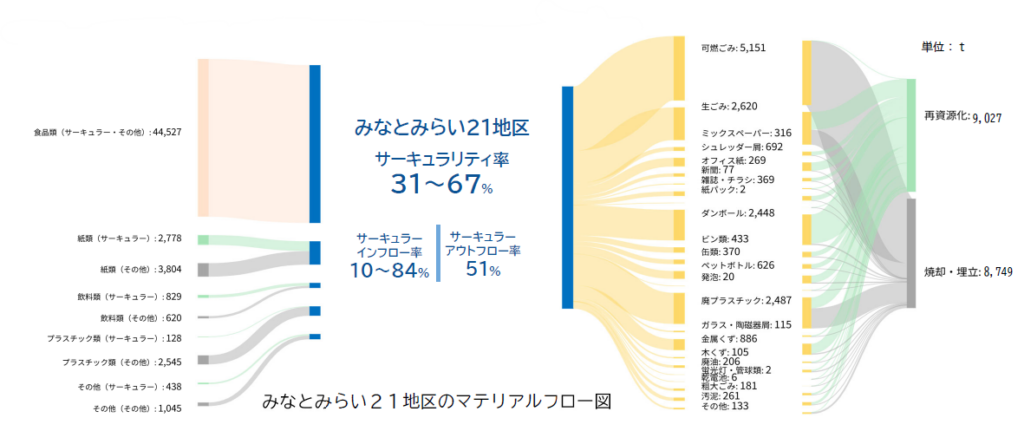
The visualization of resources flowing into and out from Minato Mirai (only available in Japanese at present).
*The visualization approach references the GCP (Global Circularity Protocol), an international framework developed by WBCSD (World Business Council for Sustainable Development) and UNEP (United Nations Environment Programme) to measure and disclose circularity in a globally comparable way. The first edition of this framework was released at UNFCCC-COP30.
Related posts:
 Yokohama’s Circular Journey: How “Civic Power” is Building a Sustainable Future [Part 1]
 From Yokohama to Asia: Sharing Pathways for Circular Cities
 Yokohama Hosts “the 5th Net Zero Emissions Workshop” at Bangkok Climate Action Week
 Yokohama presents its green initiatives at the World Cities Summit Mayors Forum 2025